Workshop Registration Now Available
Workshop registration is now open! Head to the “Workshops” section and click on “Workshop Registration”. Fill in the required fields and secure your spot — don’t miss out on these amazing technical sessions
New


Workshop registration is now open! Head to the “Workshops” section and click on “Workshop Registration”. Fill in the required fields and secure your spot — don’t miss out on these amazing technical sessions
The event program is now available for consultation. Check the schedule and plan your participation. Don't miss the opportunity to attend the keynotes and technical sessions.
View ProgramTo celebrate the XX Latin American Congress of Automatic Control, the Organizing Committee is pleased to offer an exclusive commemorative coin, made of bronze.
 Front
Front
 Back
Back
Price: MXN $1,500.00
Contact: secretario@amca.mx or jmarquezr@ipn.mx
Limited edition - Confirm your interest now!
Estimados amigos y colegas, es un placer para mí, en mi calidad de Presidente del Comité Organizador del Congreso Latinoamericano de Control Automático, invitarlos formalmente a participar en nuestra vigésima edición, que se llevará a cabo en la ciudad de Cancún, Q. Roo, México, del 13 al 17 de octubre en las instalaciones del IPN.
El Congreso Latinoamericano de Control Automático es quizá el evento más importante en el campo del control automático en América Latina, y estamos emocionados de reunir a expertos y profesionales de la región para discutir los últimos avances y tendencias en el campo.
Durante el congreso, tendremos la oportunidad de escuchar presentaciones de todos los participantes, así como 5 conferencias plenarias impartidas por reconocidos expertos en el campo. Además, los invitamos a unirse a nosotros en los eventos sociales que hemos organizado para que puedan conocer y conectar con otros asistentes: no se pierdan la recepción de bienvenida, donde podrán disfrutar de un ambiente relajado y conocer a otros asistentes. También los invitamos a la cena de gala, que será un momento especial para celebrar la conclusión del congreso y fortalecer las relaciones establecidas durante el evento.
Además de disfrutar de un programa académico de alta calidad, los invitamos a aprovechar su estancia en Cancún para explorar las riquezas naturales, culturales y gastronómicas de la región. Desde las impresionantes ruinas mayas hasta los hermosos paisajes de la Riviera, y desde la deliciosa comida yucateca hasta la vibrante vida nocturna de la ciudad, hay algo para todos en Cancún.
Esperamos que puedan unirse a nosotros en este importante evento y compartir sus conocimientos y experiencias con la comunidad de control automático de América Latina.
Agradecemos de antemano su consideración y esperamos verlos pronto en el CLCA 2025.
Atentamente,
Basilio del Muro Cuéllar
Presidente del Comité Organizador
 IMPORTANT DATES
 Start of article reception: March 24
Deadline for article reception:
June 20 Extended date: June 27
 Final deadline: Monday June 30
Deadline for special session reception: June 20
Deadline for special session articles: June 20
Results publication: August 11
New date: August 17
Final versions submission: From August 18 to 31
New date: September 7
Early registration deadline: September 12
FECHAS IMPORTANTES Inicio de recepción de artículos: 24 de marzo
Límite para recepción de artículos:
20 de junio Fecha extendida: 27 de junio
Última fecha límite: lunes 30 de junio
Límite para recepción de sesiones especiales: 20 de junio
Límite para artículos de sesiones especiales: 20 de junio
Publicación de resultados: 11 de agosto
Nueva fecha: 17 de agosto
Envío de versiones finales: Del 18 al 31 de agosto
Nueva fecha: 7 de septiembre
Límite para inscripción anticipadas: 12 de septiembre
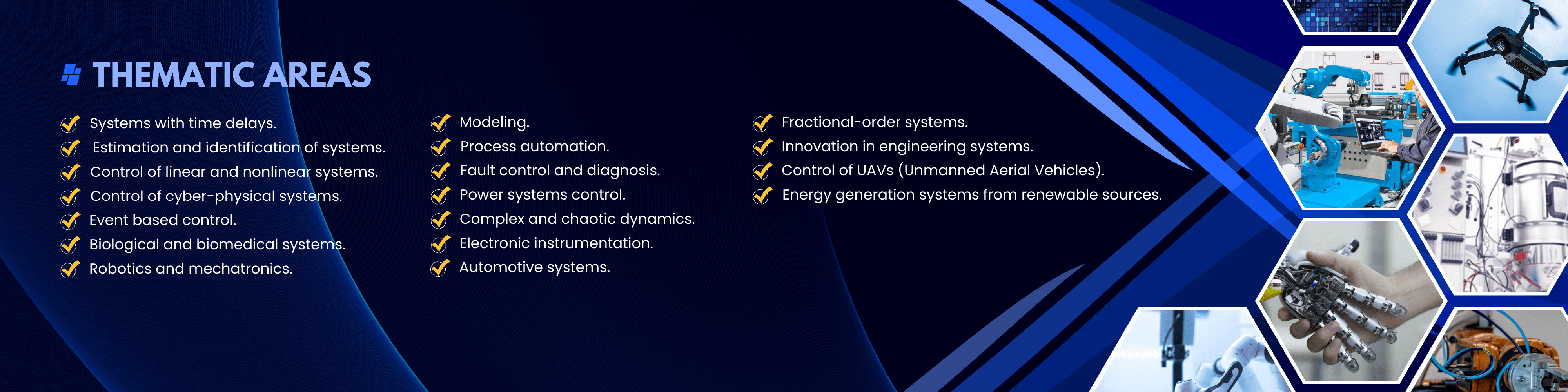
En esta ocasión el Congreso Latinoamericano contará con las siguientes opciones:
Opciones de Publicación:
i) Publicación en las Memorias del Congreso Nacional de Control Automático, ISSN:2594-2492. Los trabajos podrán escribirse en español, inglés o portugués.
ii) Publicación en un libro de la serie de Springer: Studies in Systems, Decision and Control (SSDC). Los artículos estarán indexados en SCOPUS y deberán ser enviados exclusivamente en inglés.
Opciones de Presentación:
i) Presentación de trabajos aceptados por medio de videos previamente elaborados.
ii) Presentación en vivo con diapositivas preparadas.
El inicio de la recepción de artículos será el 24 de marzo del 2025.
Los autores interesados en esta modalidad deben presentar su artículo en formato IFAC, con una extensión máxima de 6 páginas.
Los trabajos a ser publicados en la serie de Springer Studies in Systems, Decision and Control (SSDC) deberán de ser enviados exclusivamente en inglés a través de PaperCept.
La versión final debe ajustarse a los comentarios de los revisores y cumplir con:
El video deberá ser enviado a más tardar el día 7 de octubre de 2025 con una duración de 15 minutos a las direcciones: velasco@cinvestav.mx, velascovilla@gmail.com.
Los autores podrán presentar sus trabajos en persona durante el congreso, utilizando diapositivas preparadas previamente.
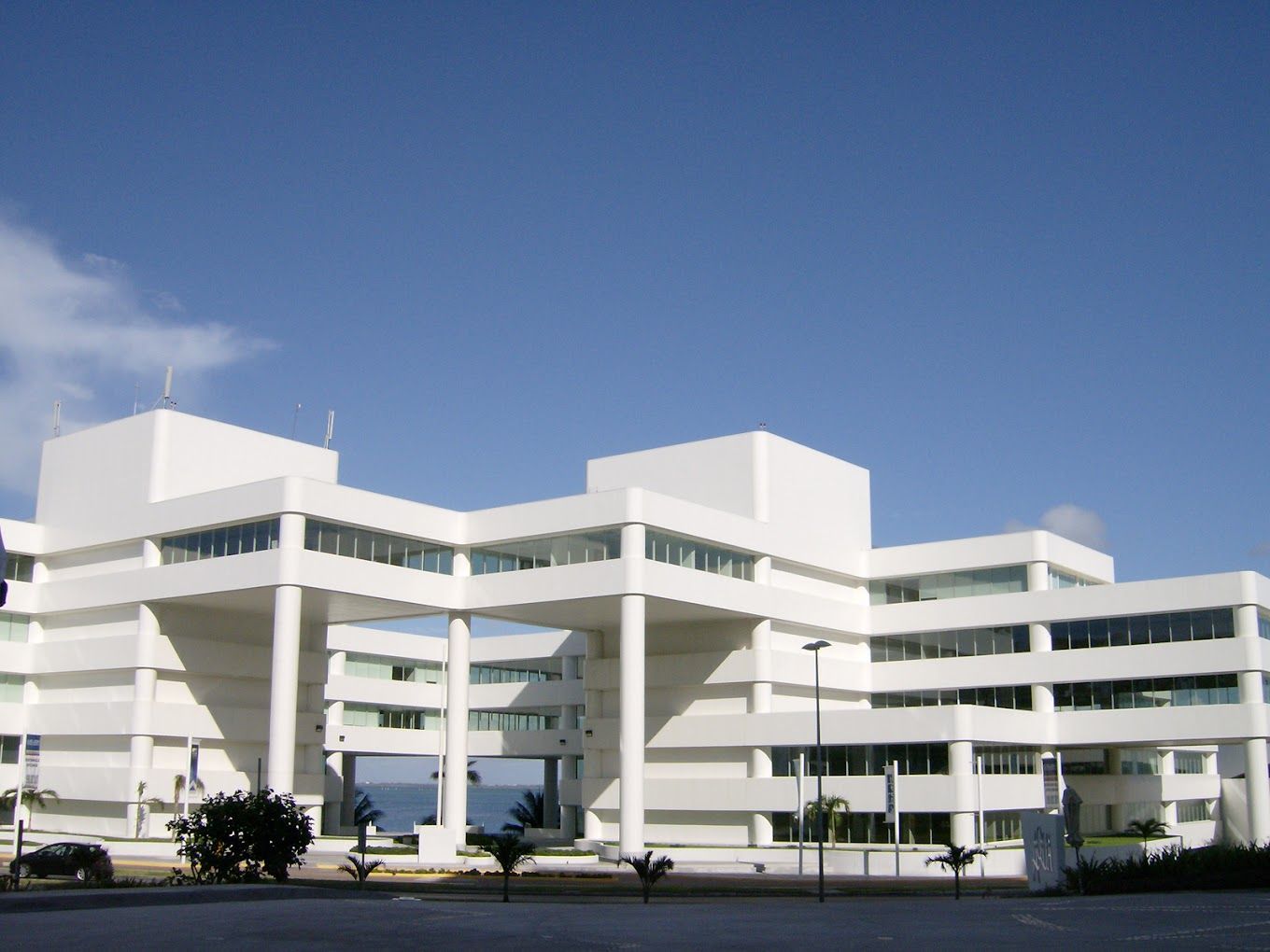
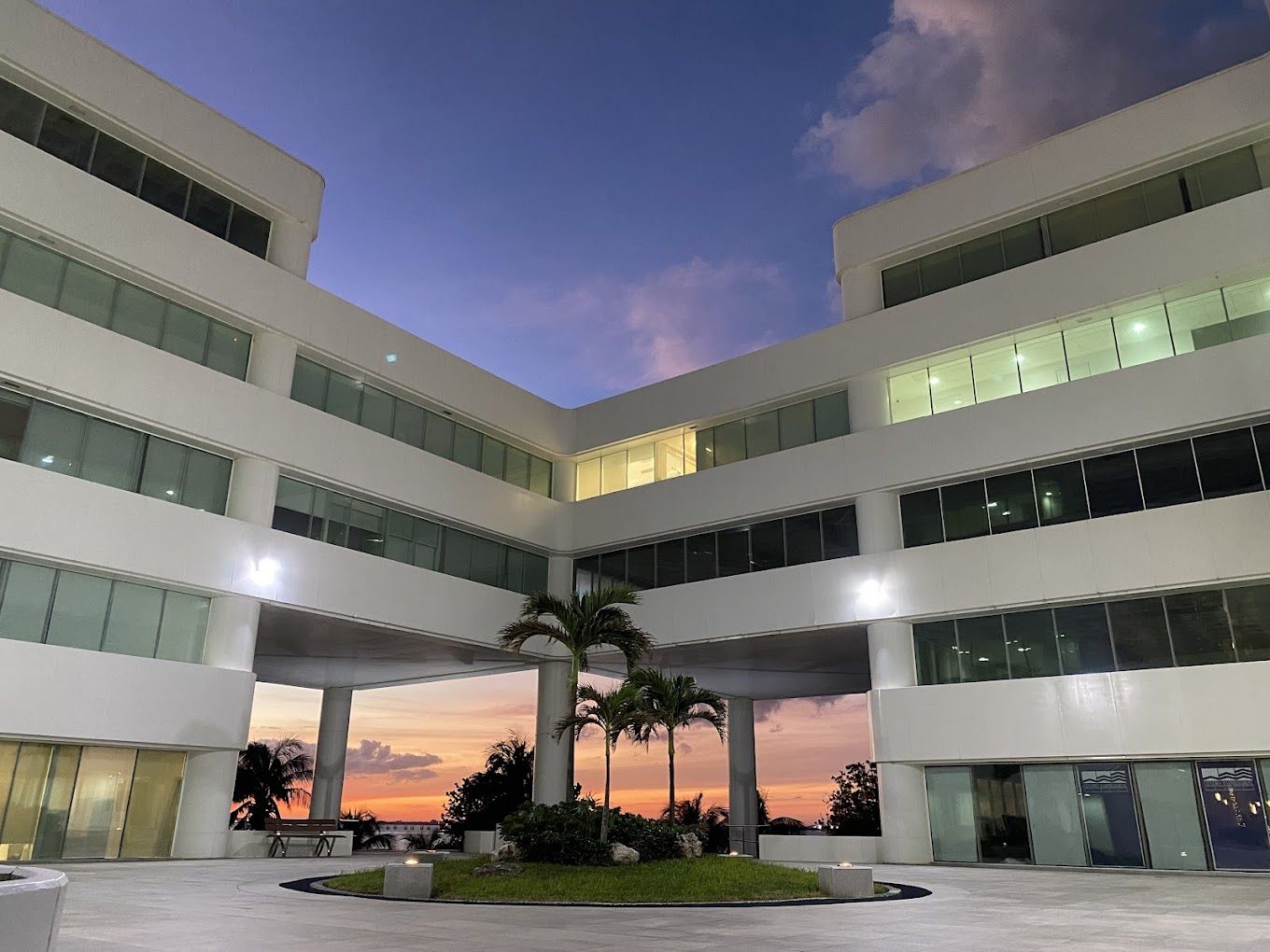
El Centro de Vinculación y Desarrollo Regional Unidad Cancún, un lugar emblemático en el corazón de Cancún, se distingue por su arquitectura moderna y su ubicación estratégica, brindando un espacio ideal para actividades académicas y profesionales. Este centro cuenta con espacios multifuncionales, equipados con tecnología avanzada, perfectos para conferencias, congresos y exposiciones.
Con amplios salones de reuniones y áreas de exposiciones, el centro se posiciona como un punto clave para el desarrollo profesional y académico. Además de su capacidad para albergar eventos de gran importancia, el Centro de Vinculación y Desarrollo Regional Unidad Cancún ofrece un ambiente cómodo y profesional, ideal para el networking y el intercambio de ideas en el campo de la ingeniería y las ciencias.
En el marco del evento CLCA 2025, este centro se convierte en el lugar perfecto para fomentar el intercambio de conocimientos, promoviendo el desarrollo y la colaboración entre profesionales y académicos de toda la región latinoamericana.

Instituto Politécnico Nacional
Instituto Politécnico Nacional

Instituto Politécnico Nacional

CINVESTAV-IPN

CINVESTAV-IPN
| Name | Institution | Country |
|---|---|---|
| Gaston Lefranc | Pontificia Universidad Católica de Valparaíso | Chile |
| Karina A. Barbosa | Universidad de Santiago de Chile. Departamento de Ingeniería Eléctrica | Chile |
| Javier Jiménez Cabas | Universidad de la Costa | Colombia |
| John Alexander Cortés Romero | Universidad Nacional de Colombia | Colombia |
| Lucía Quintero | Universidad EAFIT | Colombia |
| Nicanor Quijano | Universidad de los Andes | Colombia |
| Adolfo Chaves Jiménez | Instituto Tecnológico de Costa Rica | Costa Rica |
| Oscar Camacho | Universidad San Francisco de Quito USFQ | Ecuador |
| Joaquim Blesa | Universitat Politecnica de Catalunya (UPC) | Spain |
| José Manuel Andújar | University of Huelva | Spain |
| Ramon Costa Castelló | Universidad Politécnica de Cataluña | Spain |
| Rodolfo Reyes Báez | Mechatronics Engineer at ASML | Netherlands |
| José Corona | The Arctic University of Norway | Norway |
| Gustavo Pérez Zúñiga | Pontificia Universidad Católica del Perú | Peru |
| Orestes Llanes Santiago | Universidad Tecnológica de La Habana José Antonio Echeverría | Cuba |
| Ivón Oristela Benítez González | Universidad Tecnológica de La Habana José Antonio Echeverría | Cuba |
| Marcos Quiñones Grueiro | Universidad Vanderbilt | USA |
| Miguel Rios Bolivar | Universidad de Andes | Venezuela |
| Jose-Job Flores Godoy | Universidad Católica del Uruguay | Uruguay |
| Jóse Fermi Guerrero Castellanos | Benemérita Universidad Autónoma de Puebla | Mexico |
| César Cruz Hernández | Centro de Investigación Científica y de Educación Superior de Ensenada | Mexico |
| Luis Alejandro Marquez Martínez | Centro de Investigación Científica y de Educación Superior de Ensenada | Mexico |
| Eduardo Aranda Bricaire | Centro de Investigación y de Estudios Avanzados – IPN | Mexico |
| Fernando Castaños | Centro de Investigación y de Estudios Avanzados – IPN | Mexico |
| Hugo Rodríguez Cortés | Centro de Investigación y de Estudios Avanzados – IPN | Mexico |
| Martha Belem Saldivar Márquez | Centro de Investigación y de Estudios Avanzados – IPN | Mexico |
| Sabine Mondié Cuzange | Centro de Investigación y de Estudios Avanzados – IPN | Mexico |
| Emmanuel Nuño Ortega | Centro Universitario de Ciencias Exactas e Ingeniería – UdeG | Mexico |
| Sofía Avila Becerril | Facultad de Ingeniería – UNAM | Mexico |
| Efraín Alcorta García | Facultad de Ingeniería Mecánica y Eléctrica – UANL | Mexico |
| Alejandro Gutierrez Giles | Instituto Nacional de Astrofísica, Óptica y Electrónica | Mexico |
| Juan Gonzalo Barajas Ramírez | Instituto Potosino de Investigación Científica y Tecnológica | Mexico |
| Guillermo Valencia Palomo | TecNM / Instituto Tecnológico de Hermosillo | Mexico |
| Omar Hernández González | TecNM / Instituto Tecnológico de Hermosillo | Mexico |
| Alejandro Dzul López | TecNM / Instituto Tecnológico de la Laguna | Mexico |
| Luis Néstor Coria de los Ríos | TecNM / Instituto Tecnológico de Tijuana | Mexico |
| Nohe Cazarez Castro | TecNM / Instituto Tecnológico de Tijuana | Mexico |
| Marcos Ángel González Olvera | Universidad Autónoma de la Ciudad de México | Mexico |
| Elvia Ruth Palacios Hernández | Universidad Autónoma de San Luis Potosí | Mexico |
| Ricardo Álvarez Salas | Universidad Autónoma de San Luis Potosí | Mexico |
| Hector Puebla Núñez | Universidad Autónoma Metropolitana – Azcapotzalco | Mexico |
| Alma Alanís García | Universidad de Guadalajara | Mexico |
| Flor Lizeth Torres Ortiz | Universidad Nacional Autónoma de México – Instituto de Ingeniería | Mexico |
| Alejandro Rodríguez Angeles | Centro de Investigación y de Estudios Avanzados – IPN | Mexico |
| Cristina Verde | Universidad Nacional Autónoma de México – Instituto de Ingeniería | Mexico |
| Gerardo Espinosa Perez | Facultad de Ingeniería – UNAM | Mexico |
| Ixbalank Torres Zúñiga | Universidad de Guanajuato | Mexico |
| Jaime A. Moreno | Instituto de Ingeniería, UNAM | Mexico |
| Jesús Leyva Ramos | Instituto Potosino de Investigación Científica y Tecnológica | Mexico |
| Joaquín Álvarez | Centro de Investigación Científica y de Educación Superior de Ensenada | Mexico |
| Luis Álvarez Icaza | Instituto de Ingeniería, UNAM | Mexico |
| Marco A. Arteaga | Universidad Nacional Autónoma de México | Mexico |
| Rafael Castro Linares | Centro de Investigación y de Estudios Avanzados – IPN | Mexico |
| Rubén Garrido | Centro de Investigación y de Estudios Avanzados – IPN | Mexico |
| Víctor Cárdenas | Universidad Autónoma de San Luis Potosí | Mexico |
| Víctor Santibáñez | Instituto Tecnológico de La Laguna | Mexico |
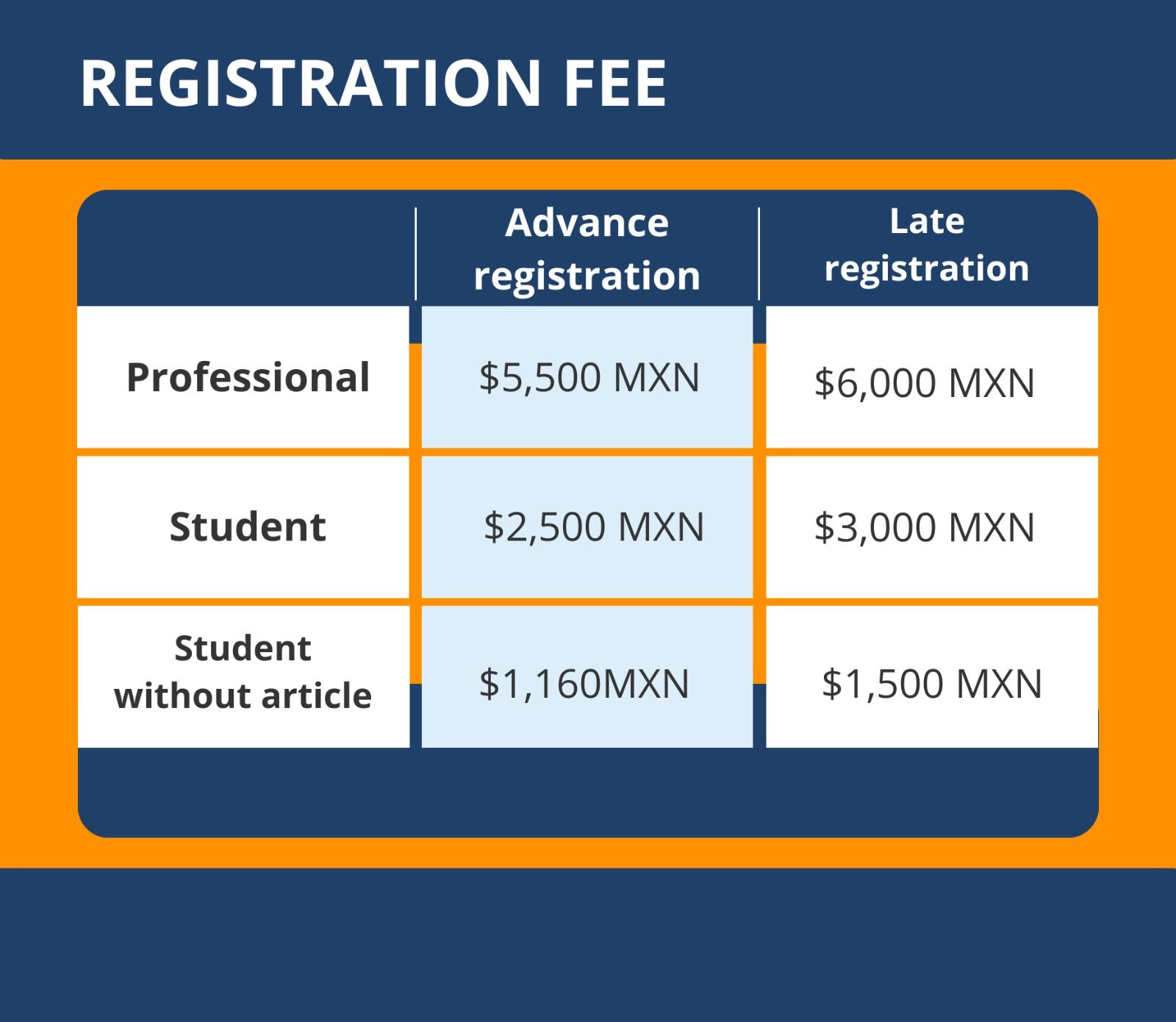
Profesional/Profesor/Investigador: Persona dedicada a la docencia a nivel superior, la investigación o cualquier actividad en el sector público y/o privado.
Estudiante: Estudiante con artículo aceptado.
Estudiante oyente: Estudiante sin artículo.
Si un autor ha subido un artículo utilizando su registro pagado, la inscripción no será devuelta, incluso si el artículo se retira o el autor no puede asistir al congreso.
Todas las solicitudes de cancelación o reembolso deben hacerse por escrito al presidente del congreso, quien las canalizará al tesorero para ser procesadas. Las solicitudes serán procesadas de la siguiente manera:
Once you have completed your payment, you must fill out the event registration form.
Please remember to save your payment receipt in PDF format. If you are a student, you must attach proof of student status in the same PDF file.
If you require an invoice, the necessary fields are available in the registration form.
Invoices are generated within 3-4 business days and will be sent from factura360.com to the registered email address. If you haven’t received your invoice after this period, please check your spam folder.
Congress Chair:
presidente@amca.mx
Selecciona tu idioma | Select your language
La 2ª Reunión de Mujeres Latinoamericanas en Ingeniería de Control es un evento que se llevará a cabo el 13 de octubre de 2025, en el marco del XX Congreso Latinoamericano de Control en Cancún, México. La reunión está abierta a todas las mujeres interesadas en la ingeniería de control, sin importar su afiliación a IFAC. Su objetivo es proporcionar una plataforma para que mujeres de toda América Latina en el área de control puedan conectarse, establecer redes de colaboración y compartir sus experiencias.
¡Descarga la convocatoria para concursar por becas dirigidas a estudiantes de posgrado, académicas y profesionales interesadas en participar en el evento!
¡No pierdas la oportunidad de postularte!
Descargar ConvocatoriaThe 2nd IFAC Latin America Women in Control Engineering Meeting (2nd IFAC LA-WICE Meeting) is an event that will be held on October 13, 2025, during the XX Latin American Control Congress in Cancún, Mexico. The meeting is open to all women interested in control engineering, regardless of their affiliation with IFAC. Its purpose is to provide a platform for women in control engineering across Latin America to connect, network, and share their experiences.
Download the call for applications to apply for scholarships aimed at graduate students, academics, and professionals interested in participating in the event.
Don't miss the opportunity to apply!
Download Scolarship Call

Linear Parameter-Varying (LPV) systems are state-space representations that depend on time-varying parameters and are useful for modeling various types of complex dynamic systems, such as uncertain or nonlinear systems. In recent decades, various computational and mathematical tools have been used for the analysis and control of LPV systems, with Linear Matrix Inequalities (LMIs) being particularly noteworthy.
In this context, this workshop will focus on both theoretical and practical approaches to applying LMIs for stability analysis and control of LPV systems. It will begin with a brief introduction to LPV system modeling, followed by addressing challenges related to the stability, performance, and robustness of these systems.
For the proper development of the workshop, basic knowledge of control systems and basic use of MATLAB is required. Additionally, participants should have MATLAB and YALMIP installed, along with a solver for LMIs (semidefinite programming) such as MOSEK, SeDuMi, or SDPT3.
Dr. Karina A. Barbosa is currently Vice Dean of Teaching and Professional Training at the Faculty of Engineering, USACH, Associate Professor in the Department of Electrical Engineering at the University of Santiago, Chile, and mother of two teenagers.
She holds a Bachelor's degree in Applied and Computational Mathematics (1997) from the Federal University of Rio Grande do Sul (UFRGS), and both a Ph.D. (2003) and Master's degree (1999) in Electrical Engineering from the Federal University of Santa Catarina (UFSC), Brazil.
Currently, she serves as Chair of the IEEE Chile Control Chapter, is part of the board of directors of the Chilean Association of Automatic Control (ACCA), and has been an IEEE Senior Member since 2017. Her research focuses on robust control theory, particularly the development of control and state estimation methods based on LMIs and parameter-dependent Lyapunov functions for uncertain systems, LPV systems, and applications in energy systems, with publications in recognized journals.
She has been principal investigator and co-investigator in FONDECYT, DICYT, and FONDEF projects in both control theory and its applications, primarily in energy systems. In 2024, she served as Chair of the IEEE ICA ACCA 2024 conference and was responsible for the organizing committee of the first IFAC Latin American Women in Control Engineering (IFAC LA-WICE) meeting, both held in Santiago, Chile.

This course provides essential fundamentals for modeling, controller design, and real-time implementation for aerial vehicles. Starting from a general model, dynamic models of aircraft with different configurations are built modularly, based on the analysis of the aerodynamic actuators that compose them. The problem of rotational kinematics control is addressed, considering the nonlinear nature of the configuration space.
Finally, the characteristics of available sensors and actuators are described, as well as their integration with a digital signal processor. The control schemes are illustrated through a flight simulator and the use of MATLAB/Simulink.
Basic knowledge of dynamic systems and control theory is recommended. Familiarity with MATLAB/Simulink will be helpful for the practical sections of the workshop.
Dr. Hugo Rodríguez Cortés holds a degree in Aeronautical Engineering from the National Polytechnic Institute (IPN) and a Master's degree in Electrical Engineering from CINVESTAV-IPN. He earned his Ph.D. in Automation and Signal Processing at the Signals and Systems Laboratory located in Gif-sur-Yvette, France.
He has been a research associate at Imperial College London (UK) and Northeastern University (Boston, USA). He has also been a visiting professor in the Operations Research and Electrical and Electronic Engineering departments at the Autonomous Technological Institute of Mexico (ITAM) and has collaborated as a scientific advisor at the Aerospace Development Center of IPN.
Currently, he is a researcher in the Mechatronics Section of the Electrical Engineering Department at CINVESTAV-IPN. He served as president of the Mexican Association of Automatic Control (AMCA) and of the Program Committee for the National Congress of Automatic Control (CNCA) 2018. Additionally, he is part of the Editorial Committee of the International Journal of Intelligent and Autonomous Systems (JINT) and the conferences International Conference on Unmanned Aircraft Systems (ICUAS) and CNCA. He is a member of the National System of Researchers.

This plenary is partially supported by the IFAC Distinguished Lecturer Program
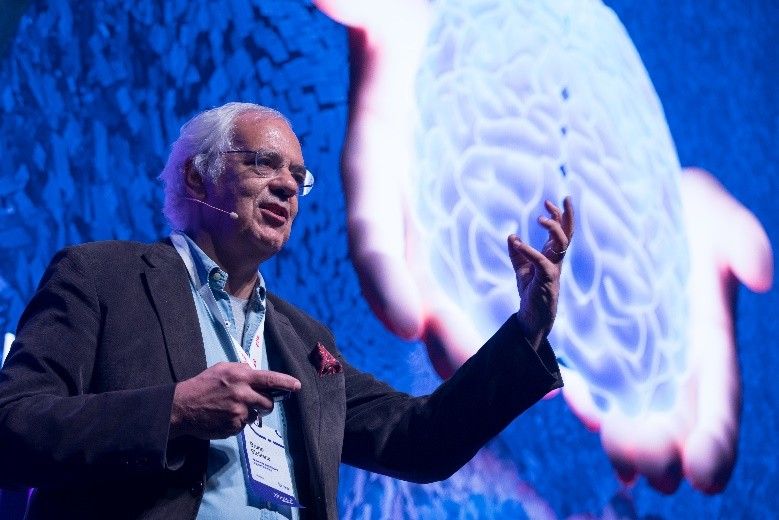
This plenary session presents research results from PRISMA Lab on robot manipulation and control. The talk is organized in four parts. In the first part, control techniques for dynamic nonprehensile manipulation are presented. The second part of the talk focuses on how to merge learning and model-based strategies to provide autonomy to robot manipulation. In the third part, several aerial robotics applications for inspection and maintenance are surveyed. The fourth part of the talk deals with recent advances on shared control including haptic guidance.
Bruno Siciliano is professor of robotics and control at the University of Naples Federico II. He is also Honorary Professor at the University of Óbuda where he holds the Kálmán Chair. His research interests in robotics include manipulation and control, human–robot cooperation, and service robotics.
Fellow of the scientific societies IEEE, ASME, IFAC, he has received numerous international prizes and awards, including the recent 2024 IEEE RAS Pioneer Award in Robotics and Automation. He was President of the IEEE Robotics and Automation Society from 2008 to 2009.
He has delivered more than 150 keynotes and has published more than 300 papers and 7 books. His book "Robotics" is among the most adopted academic texts worldwide, while his edited volume "Springer Handbook of Robotics" has received the highest recognition for scientific publishing: the 2008 PROSE Award for Excellence in Physical Sciences & Mathematics.
His team has received more than 25 million Euro funding in the last 18 years from competitive European research projects, including two ERC grants. More details are available at http://wpage.unina.it/sicilian/

Climate change has made rural community environments susceptible to water shortages, impacting crop yields. A water-energy-food management system is proposed based on a robust predictive control strategy to address these issues. A medium-term optimisation estimates the necessary water demand required to support crop growth and high yield, and a short-term optimisation determines optimal crop irrigation and reserve water.
Both optimisations are based on predictive control strategies and use fuzzy evolving prediction intervals to characterise the dynamics and uncertainties of climate conditions that mainly influence the energy and water microgrids. The integrated food-water-energy management system improves the sustainability of water resources according to energy availability/costs and water use requirements.
Doris Sáez (Senior Member, IEEE) was born in Panguipulli, Chile. She received the M.Sc. and Ph.D. degrees in electrical engineering from the Pontificia Universidad Católica de Chile, Santiago, Chile, in 1995 and 2000, respectively.
She is currently an Associate Researcher with Instituto Sistemas Complejos de Ingeniería, Santiago. She is also a Full Professor with the Department of Electrical Engineering and the Head of the Indigenous People Program, Faculty of Mathematical and Physical Sciences, University of Chile, Santiago.
She has coauthored the books Hybrid Predictive Control for Dynamic Transport Problems (Springer, 2013) and Optimization of Industrial Processes at Supervisory Level: Application to Control of Thermal Power Plants (Springer, 2002). Her research interests include predictive control, fuzzy control design, fuzzy identification, and control of microgrids.

Science, as a tool for understanding reality, has been the subject of reflections from various schools of thought, seeking to give meaning and place to scientific knowledge within the human process. In contrast, engineering and technology have received marginal attention, and reflections on these disciplines have focused mainly on a positivist line rather than critical thinking.
This raises the question of whether engineering and technology deserve reflections and introspections similar to those made for science. It is also worth questioning who should take on the task of carrying out such reflections: philosophers? engineers and technologists? or an interdisciplinary collaboration?
José Álvarez Ramírez holds a Bachelor's degree in Chemical Engineering from UASLP (1984) and postgraduate studies in Control and Dynamic Systems from UAM-Iztapalapa (1991). He is currently a Professor-Researcher at the Department of Process Engineering and Hydraulics at UAM-Iztapalapa.
His research focuses on process dynamics and control, as well as food science and technology. With an extensive academic career, he has contributed significantly to the understanding of complex systems and their control mechanisms.
Prof. Álvarez Ramírez has been particularly interested in the philosophical and epistemological aspects of engineering practice, promoting critical thinking about the role of technology in contemporary society and its impact on human development.
This plenary is partially supported by the IFAC Distinguished Lecturer Program

The explosive growth of machine learning and data-driven methodologies have revolutionized numerous fields. Yet, the translation of these successes to the domain of dynamical physical systems remains a significant challenge. Closing the loop from data to actions in these systems faces many difficulties, stemming from the need for sample efficiency and computational feasibility, along with many other requirement such as verifiability, robustness, and safety.
In this talk, we present a framework that bridges this gap by introducing novel representations for developing nonlinear stochastic control and reinforcement learning algorithms. Our approach enables efficient, safe, robust, and scalable decision-making with provable guarantees. We further demonstrate how these representations help close the sim-to-real gap, enhance data efficiency in imitation learning, and enable scalable computation of localized policies for large-scale nonlinear networked systems.
Na Li is a Winokur Family Professor of Electrical Engineering and Applied Mathematics at Harvard University and a visiting research in Mitsubishi Electric Research laboratories (MERL). She received her Bachelor's degree in Mathematics from Zhejiang University in 2007 and Ph.D. degree in Control and Dynamical systems from California Institute of Technology in 2013. She was a postdoctoral associate at the Massachusetts Institute of Technology 2013-2014.
She has held a variety of short-term visiting appointments including the Simons Institute for the Theory of Computing, MIT, and Google Brain. Her research lies in the control, learning, and optimization of networked systems, including theory development, algorithm design, and applications to real-world cyber-physical societal system.
She has been an associate editor for IEEE Transactions on Automatic Control, Systems & Control Letters, IEEE Control Systems Letters, and served on the organizing committee for a few conferences. She received the NSF career award, AFSOR Young Investigator Award, ONR Young Investigator Award, Donald P. Eckman Award, McDonald Mentoring Award, IFAC Distinguished Lecture, IFAC Manfred Thoma Medal, Ruberti Young Researcher Prize, along with other awards.

Power electronics converter technology is present across numerous fields and has become a cornerstone of the energy transition and the operation of critical systems. Its applications range from mass-consumption devices, such as cell phone and laptop chargers, and medical equipment or implants, to inverters for integrating renewable energy into electrical grids and microgrids, electric vehicles, and active power compensators for industrial systems and electrical power systems.
Although recent decades have seen significant advances in the development of semiconductors capable of switching at higher speeds and with greater current and voltage capacity, and digital systems for controlling their operation have become standard for performing simple and complex tasks, technical challenges remain where widely used classical control strategies achieve limited results or fail to meet optimal operating objectives. Many of these challenges are closely linked to the theory and methodologies of automatic control.
This conference will explore some of the development and operational challenges associated with real-world applications in photovoltaic inverters, uninterruptible power supplies, and active compensators. Based on these cases, it will identify some open problems where automatic control can provide innovative solutions, demonstrating that the interaction between control and power electronics is a fertile ground for innovation with technological and social impact.
Víctor Cárdenas received the B.Sc. degree in Electronics from the Universidad Autónoma de San Luis Potosí (UASLP), Mexico, in 1992, and the M.Sc. and Ph.D. degrees in Electronic Engineering, specializing in Power Electronics, from the National Center for Research and Technological Development, Mexico, in 1994 and 1999, respectively. Since 2000, he has been with the Engineering Department at UASLP as a Professor and Researcher.
His main research interests include power electronics and power quality for alternative energy sources, DC/AC converters, PV systems, active power filters, and digital control applied to power converters. He is author or co-authored over 200 peer-reviewed conference and journal papers, has supervised 59 M.Sc. and Ph.D. theses, and has led 44 projects funded by industry and government.
Dr. Cárdenas serves as a regular reviewer for several international journals and governmental agencies, including IEEE Transactions on Industrial Electronics, IEEE Journal of Emerging and Selected Topics in Power Electronics, Electric Power Systems Research, FONDECYT (Chile), and COLCIENCIA (Colombia).
The venue that will host both the Welcome Toast and the Event Dinner

Blvd. Kukulkán Km. 5.5 | Hotel Zone, Cancún, QRoo Mexico 77507
+52 (998) 283 0400
| ROOM TYPE | WITH BREAKFAST | WITHOUT BREAKFAST |
|---|---|---|
| Single / Boulevard View | $2,188.58 MXN | $1,895.00 MXN |
| Double / Boulevard View | $2,443.88 MXN | $1,895.00 MXN |
| Single / Lagoon View | $2,551.58 MXN | $2,258.00 MXN |
| Double / Lagoon View | $2,845.16 MXN | $2,258.00 MXN |
All guests may make their own reservations individually by contacting the reservations department directly, mentioning only the group code or using the QR code through the hotel's website. Both codes will be shared shortly.
For the 2025 edition of the CLCA, AMCA offers accommodation support to students registered for the Congress who require it and who commit to presenting their work at CLCA 2025. Support will not be provided to those who do not have a registered paper, who are not students, or who have registered solely as auditing students.
Accommodation will be provided in shared rooms with other students, in male-only or female-only rooms, as applicable.
The number of available supports is limited and will be assigned on a first-come, first-served basis. If support is granted, recipients commit to assisting with the Congress logistics if required. After completing this registration form, the committee will review the applications and request confirmation of support via email.